

A tasting reportage by Dante Cerioli
Exclusive eveningSUPER TUSCANSOLAIA
Six Solaia vintages, from 1997 back to 1985. Tignanello 1983 and Saffredi 1993. Fourteen guests and a magnificent evening to preserve in the Journal.
Osteria de l’Umbreleèr · Cicognolo, Cremona
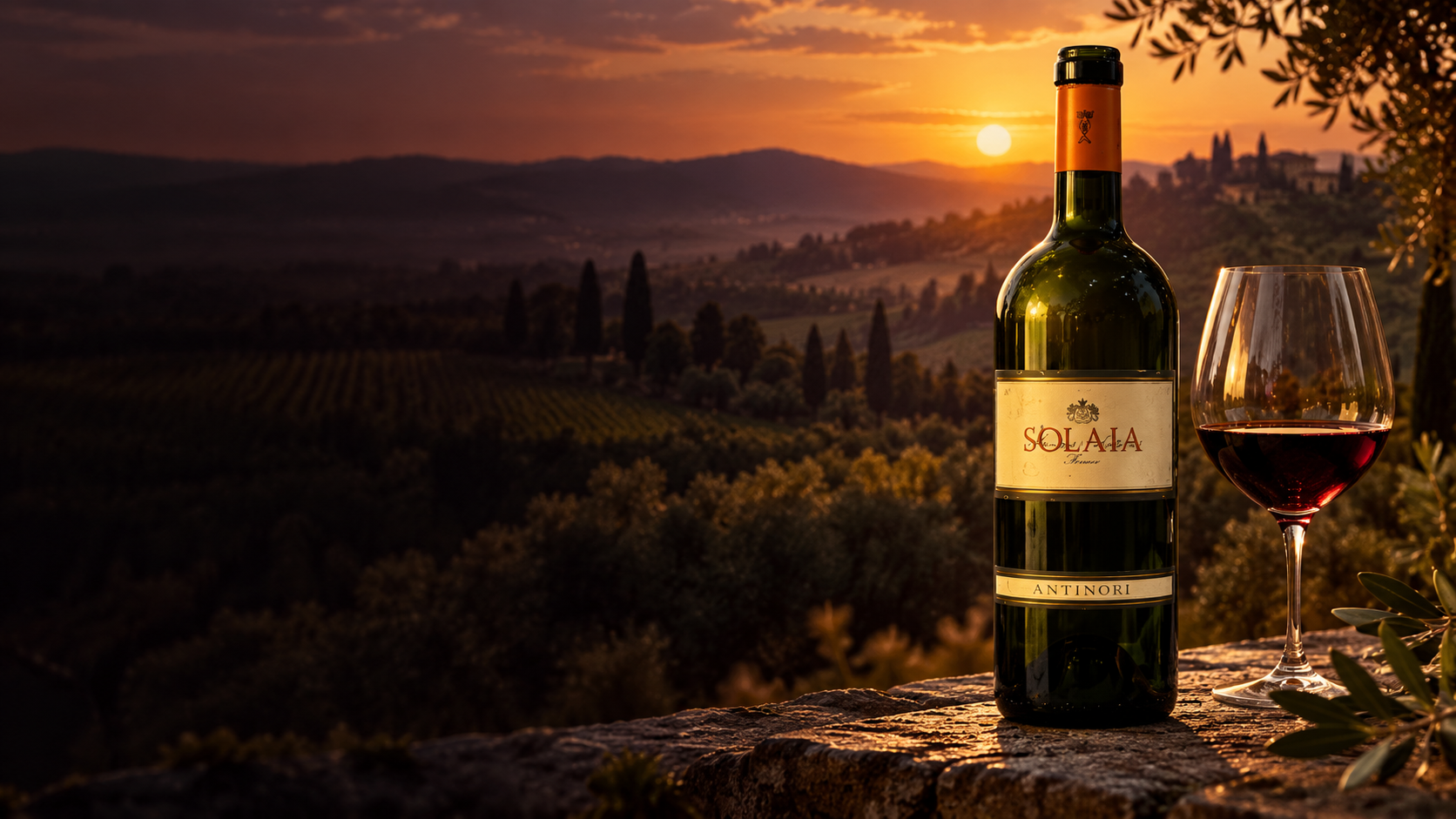
Illustrative cover · An imagined Tuscan landscape
The moment
Fourteen people. One shared memory.
On Friday 11 September 2026, fourteen of us gathered at Osteria de l’Umbreleèr in Cicognolo. The evening brought together a Solaia vertical and two further wines of great interest: Tignanello 1983 and Saffredi 1993.
For me, it was a magnificent evening. Part of the value of an encounter like this lies in sharing bottles that are rarely assembled at the same table. The dates on their labels guided us through fourteen harvest years, from 1983 to 1997.
Service and tasting demanded our full attention. That intensity also explains our small photographic archive: our time belonged to the evening, the wines and our guests. These photographs, the labels and the memory of the experience are what I wish to preserve in the Journal.
The programme in Events preserves the original proposal. Here I record the wines actually opened and the available photographs, alongside a documentary exploration of each vintage.
Dante Cerioli Professional sommelier
The photographs
What remains of the evening.
Between service and tasting, the evening required our full attention and left time for only a few photographs. Here we gather the available images and the details recovered afterwards. If guests send us more photographs, we will add them to this reportage.
Three details from the table
The labels, up close.
The paper, the vintages, the traces of time. A closer look at the bottles that made this evening.
Original photographs from the evening. Non-destructive colour correction in the viewer preserves the original files and label lettering.
The protagonist
Solaia. The story behind the dates.
Solaia began in 1978 on the hillside of Tenuta Tignanello. Its vineyard faces south-west, at 350–400 metres above sea level, on limestone-rich alberese and galestro soils. The first two vintages combined Cabernet Sauvignon and Cabernet Franc; Sangiovese joined later. Its changing blend reflects a history of experimentation.
Bringing six vintages together means exploring part of that history: 1997, 1995, 1994, 1990, 1988 and 1985. In September 2026, respectively 29, 31, 32, 36, 38 and 41 years separated us from those harvests. Every label bears a date; every bottle has followed its own path of storage and ageing.
Tignanello 1983, from the same family and estate, and Saffredi 1993 from Fattoria Le Pupille in coastal Maremma joined this comparison. Eight wines bringing together different places, decisions and moments in time.
The producers
A hillside. Two Antinori wines. A voice from Maremma.
The Antinori family traces its wine history to 1385, when Giovanni di Piero Antinori joined Florence’s wine merchants’ guild. Twenty-six generations form the thread of a family that has accompanied Italian wine through very different eras.
Tenuta Tignanello lies in Chianti Classico, between the Greve and Pesa valleys. Solaia and Tignanello come from the same hillside, characterised by Pliocene marine marl. The estate became part of the Antinori story in the mid-nineteenth century; in the 1970s it developed into an important site of winemaking research. The proximity of their vineyards makes comparing these two distinct wines particularly interesting.
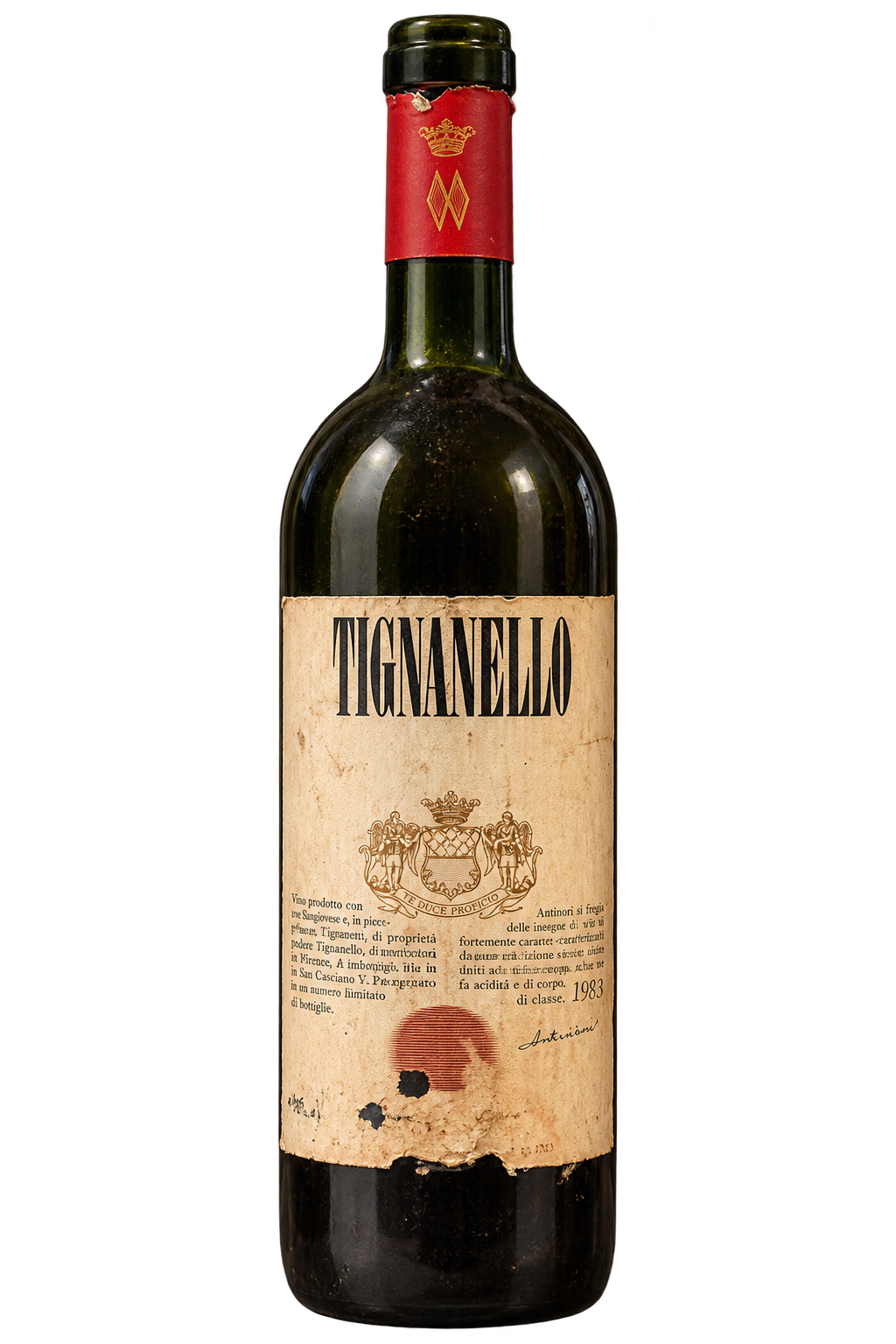
Tignanello adopted its current name with the 1971 vintage, after beginning as a 1970 Chianti Classico Riserva. White grapes were abandoned in 1975. Silvio Coppola designed its label in 1974 for the 1971 vintage: a visual signature still recognisable on the 1983 bottle photographed at our Osteria.
Saffredi takes us towards Pereta and Maremma. Its first vintage was 1987. Elisabetta Geppetti’s project, developed with Giacomo Tachis, was dedicated to Fredi, Alfredo, who helped inspire her passion for vineyards. It brings a distinct voice to Tuscany’s great red wines, represented at our table by the 1993.
Wine by wine
Eight wines. Eight chapters.
The profiles below bring together historical facts and accounts published by producers or named critics. Critical notes belong to those writers’ tastings, with their dates and bottle formats identified. They are documentary references, not a transcript of the fourteen guests’ impressions.
With mature wines, format, storage and the individual bottle matter as much as vintage. Blend percentages are included only where a source documents that specific vintage.
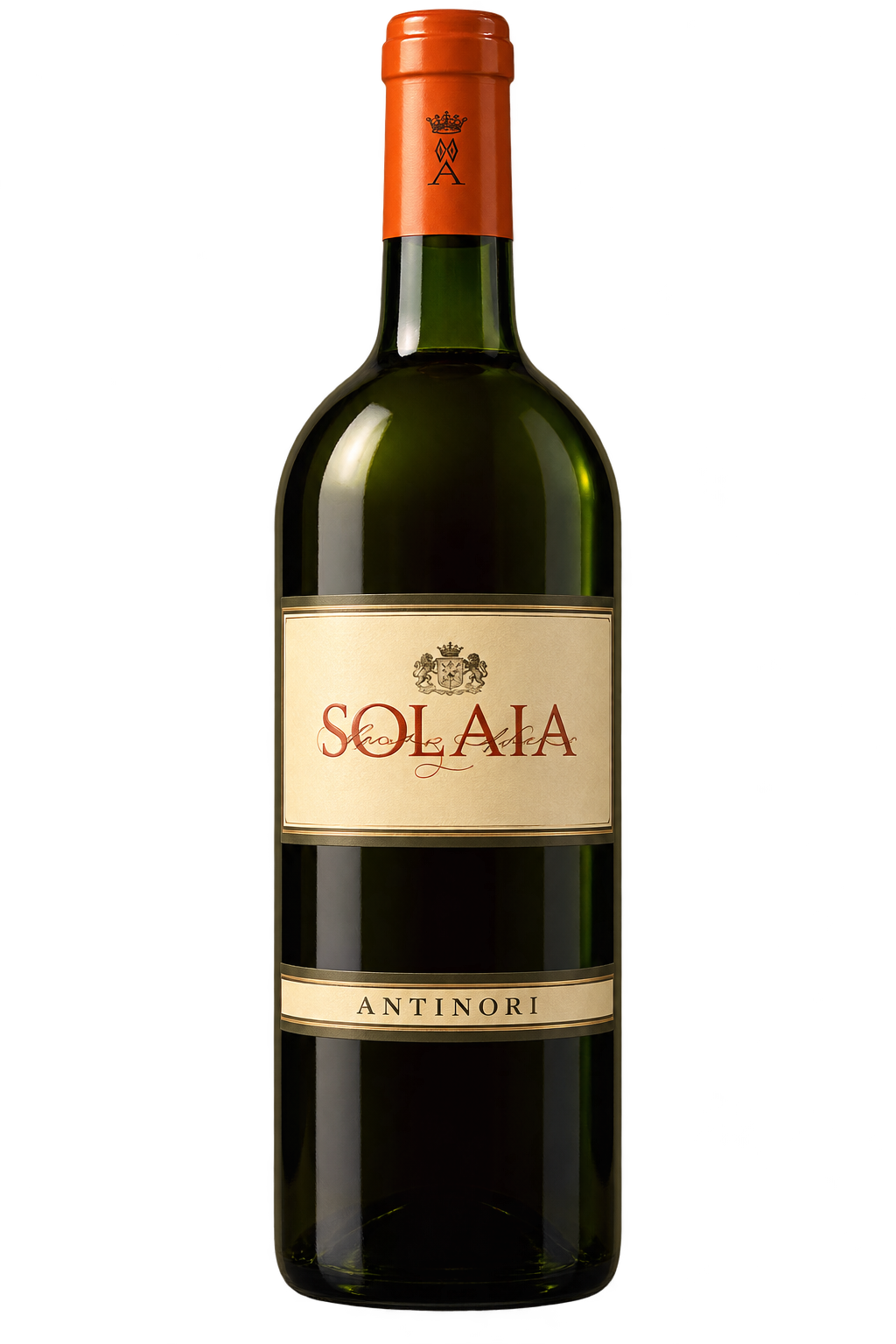
The bottle images below are illustrative reconstructions. Solaia uses a shared historical-style illustration; each vintage is identified by the adjacent text. The photographs of the actual bottles remain in the gallery above.
01 / 08 Marchesi Antinori
Solaia 1997
International recognition
29 years since harvest at the time of the evening
75% Cabernet Sauvignon · 20% Sangiovese · 5% Cabernet Franc
The 1997 brings a specific distinction to this vertical: Wine Spectator named it Wine of the Year in 2000. The vintage is 1997; the year of the award is 2000.
The documentary account
In his magnum retrospective published in 2020, Antonio Galloni emphasises its richness and still-pronounced tannic structure.
02 / 08 Marchesi Antinori
Solaia 1995
Richness and vitality
31 years since harvest at the time of the evening
In this account, 1995 precedes 1994: consecutive harvests offering a close comparison within a much wider vertical.
The documentary account
In his 2013 retrospective, Antonio Galloni describes a balance of richness and vitality, with expressive energy.
03 / 08 Marchesi Antinori
Solaia 1994
The detail of a vintage
32 years since harvest at the time of the evening
70% Cabernet Sauvignon · 20% Sangiovese · 10% Cabernet Franc
Kyle Phillips’s account of Antinori’s Vinitaly vertical records a different blend for 1994 than for 1988 and 1997. This helps trace the wine’s history through its assemblage.
The documentary account
Tasting magnum in 2020, Galloni highlights precision and transparency, with cherry, plum, mocha and rose nuances.
04 / 08 Marchesi Antinori
Solaia 1990
The depth of time
36 years since harvest at the time of the evening
Thirty-six years separate this harvest from our evening. In the sequence, 1990 bridges the mid-1990s vintages and the bottles taking us back into the 1980s.
The documentary account
In his magnum tasting published in 2020, Galloni describes opulence, ripe dark fruit, chocolate, spices and leather.
05 / 08 Marchesi Antinori
Solaia 1988
Structure and memory
38 years since harvest at the time of the evening
75% Cabernet Sauvignon · 20% Sangiovese · 5% Cabernet Franc
Kyle Phillips describes a long, warm summer in 1988, without extreme heat, favouring grape concentration. This climatic account accompanies a wine reaching our table thirty-eight years after harvest.
The documentary account
In his 2013 retrospective, Galloni values its complexity and structure, exceeding the 1985 in his comparison.
06 / 08 Marchesi Antinori
Solaia 1985
Forty-one years since harvest
41 years since harvest at the time of the evening
This is the earliest vintage in the Solaia vertical documented here. The 1985 extends the journey to forty-one years before the evening, making the individual bottle and its storage history central.
The documentary account
In 2013, Galloni describes well-stored bottles as polished and still fruity, underlining the importance of storage.
07 / 08 Marchesi Antinori
Tignanello 1983
Another voice from the hillside
43 years since harvest at the time of the evening
80% Sangiovese · 15% Cabernet Sauvignon · 5% Cabernet Franc
Tignanello belongs to the same estate as Solaia and brings Sangiovese to the centre of the comparison. The 1983 is the earliest of the evening’s eight wines: forty-three years since harvest.
The documentary account
In July 2026, Neal Martin describes a balanced, mature double magnum, with balsamic red fruit, leather and spice. He records around 24 months in French oak and Slavonian casks: facts and impressions attributed to that review.
08 / 08 Fattoria Le Pupille
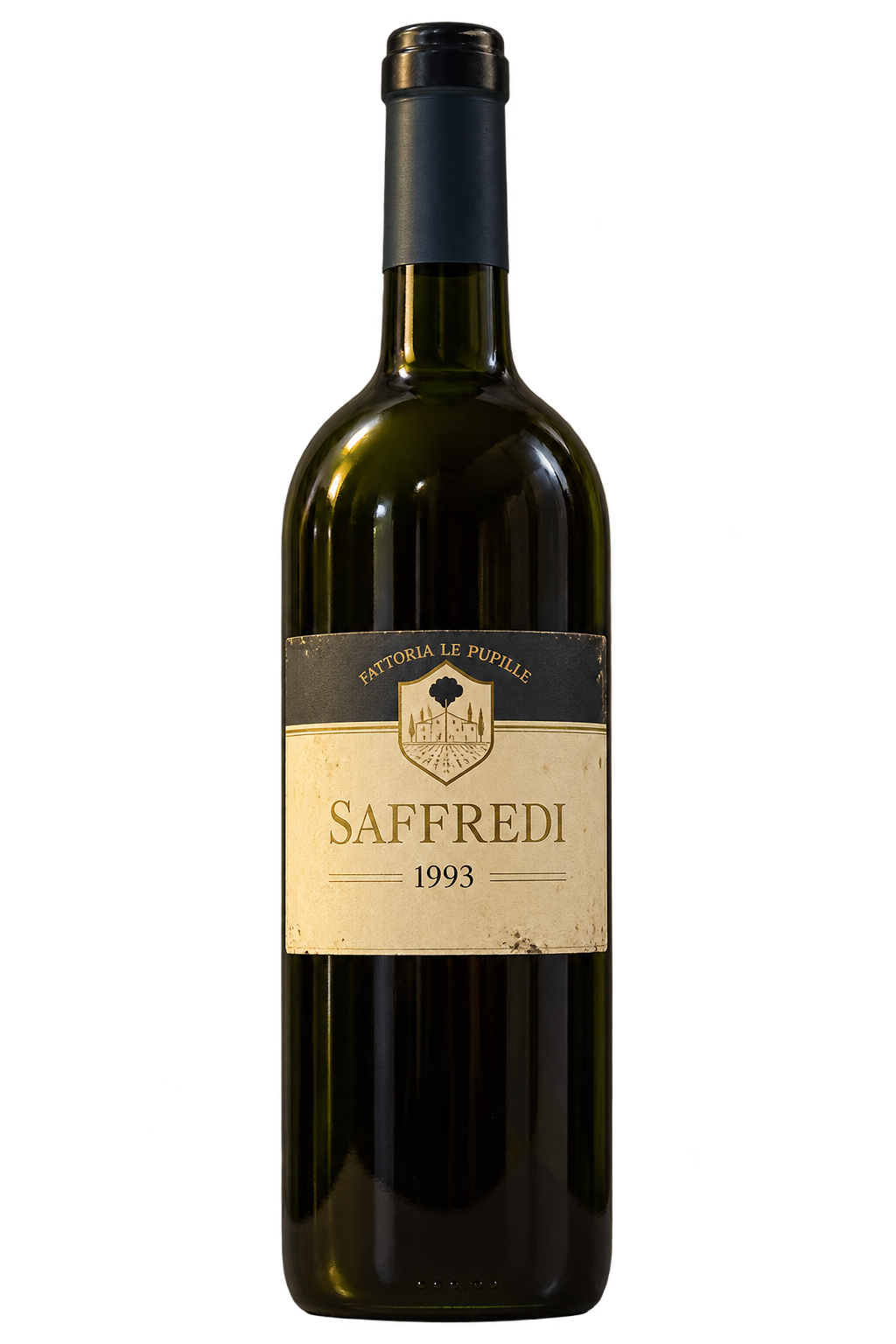
Saffredi 1993
Maremma at our table
33 years since harvest at the time of the evening
75% Cabernet Sauvignon · 18% Merlot · 7% Alicante
The estate’s archive classifies 1993 as a cool vintage and records 9,500 bottles produced. Alicante appears in its blend: a historical detail to preserve rather than replacing it with Petit Verdot from more recent formulations.
The documentary account
Writing in Bibenda no. 50 in 2014, Luca Grippo describes toasted, floral, undergrowth and balsamic notes; an austere, tannic, fresh and saline palate, finishing with chocolate and mint nuances.
At the table
The menu, preserved with the evening.
The evening’s menu is preserved on the event page: Wagyu “Cigolina”, cortile-and-thyme pasta parcels, Burgundy-style snails, Iberian “Pata Negra” pork and Comté with Luccini fig mostarda.
Read the original event and menu